
Inventions in Switzerland: LSD
Albert Hofmann's discovery of LSD-25 in 1938 was at first unspectacular. But an accident in 1943 led to the legendary bicycle ride and revealed the immense potential of the substance that was to shape the 20th century. This article examines the fascinating history of LSD, from its origin in ergot to its role in science and the counterculture.

Key points
- Albert Hofmann first synthesised LSD-25 in 1938 at Sandoz, initially with no discernible medical use.
- An accidental self-experiment in April 1943 revealed the psychoactive effect of the substance in extremely small doses.
- From 1947 LSD was used as Delysid for psychiatric research and therapy, before becoming an icon of the counterculture in the 1960s.
- Hofmann regretted the misuse of his “problem child” but lived to see the resumption of psychedelic research before his death in 2008.
A chemist from Baden
When Albert Hofmann came into the world on 11 January 1906 in Baden, Switzerland, nothing suggested that his name would one day be inseparably linked with one of the most controversial substances in human history. The family lived in modest circumstances. His father worked as a toolmaker in a factory, and when he fell ill, the young Albert had to contribute to the household income early on. It was a godfather who first made it possible for him to attend grammar school.
What shaped Hofmann as a child was not a chemical interest but an experience of nature. On a walk through the forest above Baden he was overcome by a moment of intense bliss, an overwhelming connectedness with everything living – an experience he never forgot for the rest of his life and which later moved him to pursue the question of altered states of consciousness with scientific seriousness. This early “mystical” experience forms a curious bracket around his later career: all his life Hofmann sought the chemical and philosophical explanation for that reality which cannot be captured in a test tube.
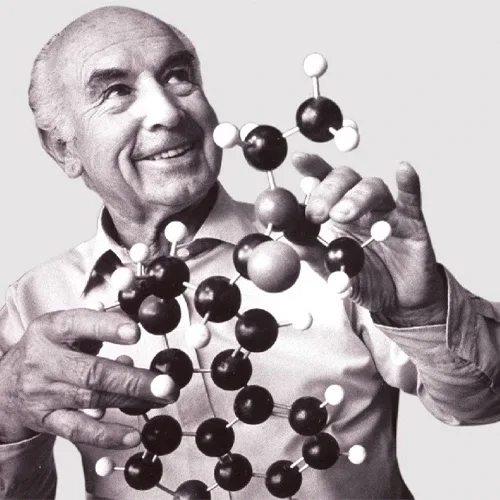
In 1929 Hofmann took his doctorate at the University of Zurich in medical chemistry. His dissertation dealt with the degradation of chitin, the shell substance of insects and crustaceans – a piece of work he completed in record time. In the same year he joined Sandoz AG in Basel, a pharmaceutical company that would later (after the merger with Ciba-Geigy in 1996) be absorbed into the Novartis group. Hofmann remained at Sandoz for his entire working life.
Ergot: an old poison with new potential
To understand how LSD came about, one has to tell the story of a fungus that had spread terror for centuries: ergot (Claviceps purpurea). This sac fungus infests rye and other cereals and forms dark, horn-shaped grains containing highly potent alkaloids. In the Middle Ages, grain contaminated with ergot repeatedly caused mass poisonings – so-called “St Anthony’s fire”, a cruel disease accompanied by burning pain, hallucinations and, in the worst case, the death of entire limbs.
Yet the same substances that make ergot so dangerous also possess medical value. Midwives had long known of its labour-inducing and haemostatic effects. In modern pharmacy this knowledge was systematised: in 1918 Arthur Stoll, a senior Sandoz chemist, isolated the first pure ergot alkaloid – ergotamine – which was used against migraine and against post-partum bleeding. In the early 1930s research groups recognised that the shared chemical core of these alkaloids was a particular compound: lysergic acid.
This is where Hofmann’s work began. He was given the task of producing new compounds on the basis of lysergic acid – in the hope that medicines with circulation- and respiration-stimulating effects could be obtained from them. Hofmann succeeded in chemically stabilising lysergic acid and combining it with various molecules. From this work came, among other things, Methergin, an agent against bleeding still used in obstetrics today, and later Hydergine, a preparation used against circulatory disorders in old age, which became one of Sandoz’s most successful products.
The twenty-fifth substance
On 16 November 1938, in the course of this series of experiments, Hofmann synthesised the twenty-fifth compound in a series of lysergic acid derivatives: lysergic acid diethylamide. From the German name “Lyserg-Säure-Diäthylamid” and the running number of the experimental series came the laboratory designation under which the substance would become world-famous – LSD-25.
Pharmacologically, the expectation was unspectacular. Hofmann hoped for a circulatory and respiratory stimulant comparable to the then-common Coramine. The animal experiments, however, disappointed. The test animals did become restless and showed a certain excitation, but the responsible pharmacologists and physicians at Sandoz saw no reason to pursue the substance further. LSD-25 was, as Hofmann later put it, set aside and forgotten for five years – one of hundreds of compounds that in pharmaceutical research find their way onto the proverbial “scrap heap” of unusable substances.
What is remarkable about this story is that LSD-25 returned at all. Usually, substances once discarded stayed discarded. But Hofmann could not let the compound go. He later spoke of a “peculiar presentiment”, a feeling that this substance had more to offer than the first tests suggested. It is one of those episodes in the history of science in which sober laboratory routine and elusive intuition intertwine in a curious way.
16 April 1943: an accident with consequences
Five years after the first synthesis, in the spring of 1943, Hofmann decided to produce LSD-25 again in order to make further samples available to the pharmacological department – an unusual step, since the substance had after all already been discarded. On the afternoon of 16 April 1943 he was carrying out the final purification steps of the synthesis when strange sensations came over him. He had to interrupt his work and go home.
In his notes Hofmann described a dreamlike state, an intoxicating dizziness, a stimulated imagination and a stream of extraordinarily vivid images of intense, kaleidoscopic colour. After about two hours the state subsided. As an experienced chemist, Hofmann drew the obvious conclusion: he must have inadvertently absorbed a small amount of the substance, presumably through the skin of his fingertips. And he immediately recognised the scientific significance – that a substance could exert such a far-reaching effect on consciousness in even the tiniest quantities was without precedent for the pharmacology of the time.
The self-experiment and the famous bicycle ride
To obtain certainty, Hofmann decided to conduct an experiment on himself. On Monday 19 April 1943, at 4.20 p.m., he took 0.25 milligrams – that is, 250 micrograms – of LSD. From today’s perspective that was a considerable dose: LSD is so potent that even a fraction of that amount produces a strong effect. Hofmann proceeded on the assumption that he had chosen a cautious threshold dose; in fact he administered to himself many times what would have been necessary for a marked effect.
The effect set in rapidly and forcefully. Hofmann asked his laboratory assistant to accompany him home. Since no automobiles were available because of the war, the two covered the distance by bicycle. This journey home entered cultural history as the legendary bicycle ride – and gave its name to the unofficial holiday still celebrated annually on 19 April: “Bicycle Day”.
During the ride Hofmann experienced a dramatic distortion of his perception. He had the impression of making no progress, although his companion assured him that they were moving along briskly. Once home, he lived through hours of deepest anxiety. He feared he would lose his mind or die; familiar objects and people transformed in his perception into something threatening, and his neighbour appeared to him at times as a malevolent witch. A doctor called to the scene could find no worrying physical signs apart from dilated pupils.
As the night wore on, the experience changed. The fear receded, and in its place came images of tremendous splendour of colour and abundance of form, a fascinating play of impressions that seemed to transform with every breath. Hofmann awoke the next morning with a clear head and a feeling of refreshment and well-being – and with the certainty that he had discovered something fundamentally new.
A substance in search of its purpose
Sandoz recognised the significance of the substance and brought LSD onto the market from 1947 under the trade name Delysid – not as an intoxicant, but as a tool for psychiatric research and therapy. The idea behind it: LSD could help psychiatrists better understand the experiential world of psychotic patients by temporarily producing a comparable state. At the same time, therapists tested the substance as an aid in psychoanalysis, to make repressed content accessible.
In the 1950s and early 1960s an extensive scientific literature emerged. Hundreds of studies examined LSD in the treatment of alcoholism, depression, anxiety disorders and in caring for the dying. The still young field of consciousness research was also interested in the substance. It was a time in which LSD counted as a serious research instrument with which the mysteries of perception, mind and mental illness were to be explored.
Hofmann meanwhile expanded his own work. In the 1950s he turned to the Mexican magic mushrooms and isolated their active substances psilocybin and psilocin – here too he was the first to achieve the synthesis. Later he investigated the active substances of a Mexican morning glory species and established their chemical kinship with LSD. His scientific interest was always in the bridge between the chemistry of plants and the effects on the human mind.
From the laboratory into the counterculture
What had begun as a sober pharmaceutical research project got out of control in the course of the 1960s – at least from the perspective of its discoverer. LSD left the laboratories and clinics and became the chemical emblem of an entire cultural movement. Figures such as the former Harvard psychologist Timothy Leary propagated mass, uncontrolled consumption as a means of expanding consciousness and achieving social liberation. LSD became the fuel of the psychedelic counterculture, shaping the music, visual art and outlook of a generation.
Hofmann followed this development with growing unease. He had nothing against the substance itself – on the contrary, he was convinced of its value. But he firmly rejected careless recreational use. For him, LSD was a tool that required respect, preparation and a protected setting, not a party pleasure. Alluding to the contradictory experiences he associated with the substance, he coined for it the designation that became famous: his “problem child”, a compound of extraordinary potential whose misuse deeply saddened him.
Society’s reaction was not long in coming. In view of mass recreational consumption and the associated risks, numerous states banned LSD in the course of the late 1960s. Sandoz discontinued production in 1965. With the ban, legal research also largely came to a standstill – a circumstance Hofmann regretted, because he saw the substance’s therapeutic potential left untapped. In his view the problem was not the substance but the irresponsible handling of it.
A long life and a late return
Albert Hofmann remained at Sandoz until his retirement in 1971, where he latterly headed the natural products department. He remained scientifically and journalistically active afterwards too. In 1979 he published his memoirs under the title LSD – My Problem Child, a book that recounts the story of his discovery at first hand and is still regarded as a classic of scientific literature. It also contains the often-quoted thought that he had not chosen LSD, but that LSD had found him and called him – a formulation that captures the peculiar relationship between the chemist and his most famous creation.
Hofmann reached an exceptionally great age. Towards the end of his life he witnessed the scientific climate beginning to change and a new generation of researchers rediscovering the therapeutic potential of psychedelic substances under strict scientific conditions – for instance in the treatment of depression, anxiety and trauma. He experienced the beginnings of this renaissance of psychedelic research, which he had wished for so long. On the occasion of his hundredth birthday in January 2006 he was honoured in Basel with an international symposium that brought together scientists from all over the world.
Albert Hofmann died on 29 April 2008 at the age of 102 in his house in Burg, canton of Basel-Landschaft, of a heart attack. He left behind an ambivalent legacy: a substance that counts equally as a symbol of excessive drug culture and as a bearer of hope for psychiatry.
The legacy of a presentiment
The story of Albert Hofmann and LSD is more than the anecdote of a happy accident. It tells of the narrow line between poison and remedy, of the unpredictability of scientific discoveries and of the responsibility that goes with them. A substance intended as a respiratory stimulant, discarded and returned only through a scarcely explicable presentiment of its creator, became the focal point of medicine, law, art and social policy.
Hofmann himself remained all his life a sober natural scientist who nonetheless took the mystical dimension of human experience seriously. In that forest clearing above Baden, where as a child he had felt the overwhelming connectedness with all life, he saw in retrospect a foreshadowing of what LSD later made chemically accessible to him. That of all people a reserved Basel chemist should become the involuntary godfather of a worldwide counterculture is one of the great ironies in the history of science – and yet it suits a substance that, like hardly any other, turned the expectations of its time on their head.
References
- Albert Hofmann, „LSD – Mein Sorgenkind" (1979)
- Encyclopædia Britannica, Biografie Albert Hofmann
- The Lancet, Nachruf (2008)
- Smithsonian Magazine