
Pharmacy closures in Switzerland: what the figures really show
Pharmacies in Germany are closing at record speed, and the phrase “pharmacy death” is doing the rounds here too. But do the Swiss figures actually support it? The fact check shows: the total number is astonishingly stable — beneath the surface, however, a structural shift is under way whose drivers are less rural exodus than margin pressure, a shortage of new blood and the peculiarities of the Swiss dispensing system.

Key points
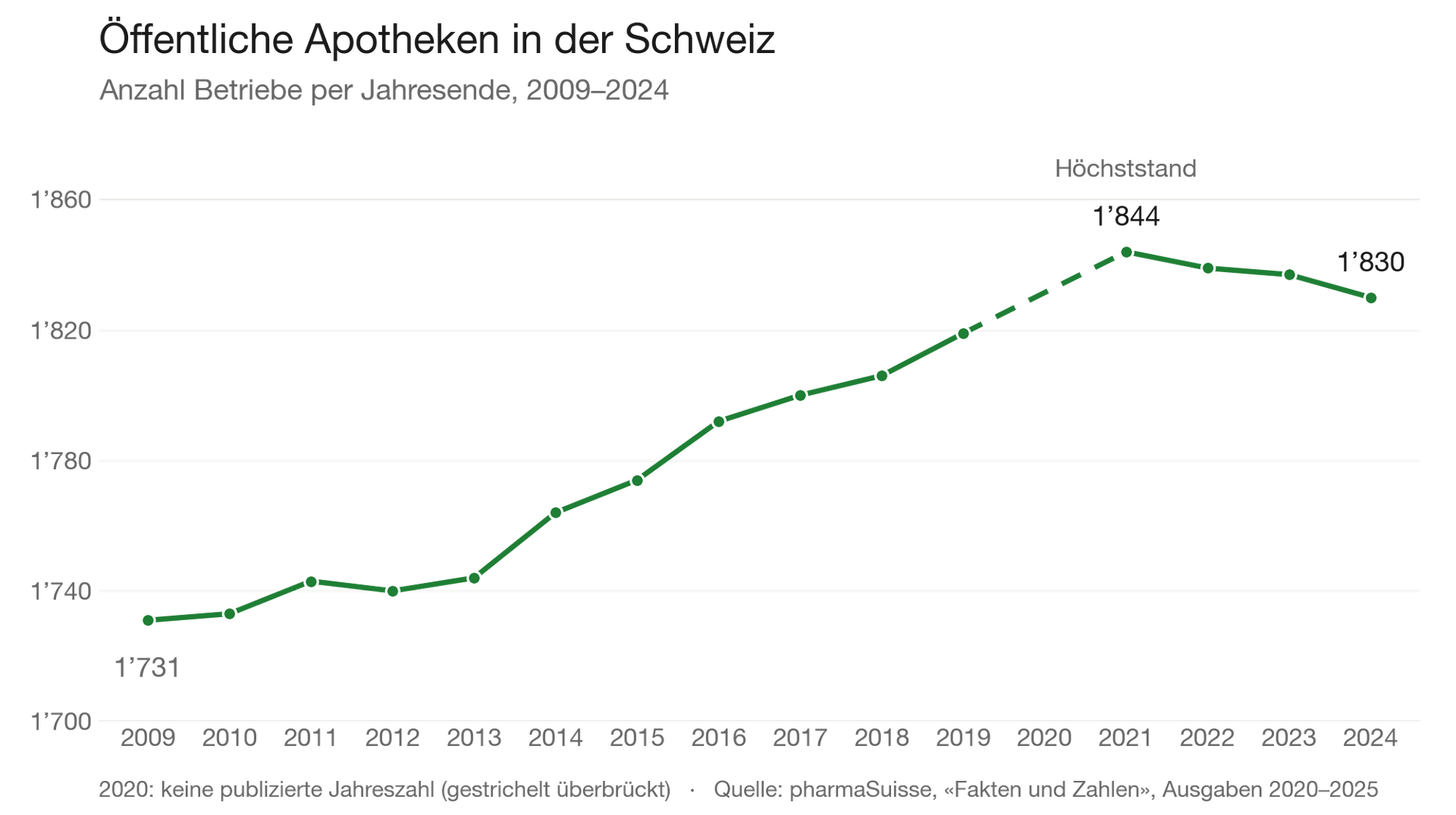
- No collapse, but a turning point: with 1,830 pharmacies (end of 2024) the Swiss network has been stable since 2008 — since 2021, however, it has been shrinking slightly, and analysts expect a creeping consolidation.
- Rural exodus is not the main driver: pharmacy density follows first and foremost the dispensing regime — in self-dispensing cantons 8,456 inhabitants share one pharmacy, in Rx cantons only 3,274.
- The real reasons: reduced distribution margins (revision as of 1 July 2024), LOA tariffs stagnant for years, rising personnel and operating costs, only 192 pharmacy diplomas a year and unpaid extra work caused by more than 1,200 supply shortages.
- The opportunity: pharmaSuisse positions the pharmacy as the first point of contact in primary care — a third of the population has already saved a doctor’s visit thanks to pharmacy counselling, and 82 per cent of businesses vaccinate.
A term migrates across the border
The word “pharmacy death” comes from the German debate — and there it is no exaggeration: the number of pharmacies in Germany has fallen from around 21,500 in 2000 to roughly 17,000, with several hundred businesses disappearing in 2024 alone. In the United Kingdom around 700 of 14,000 pharmacies closed within two years; in the USA the chain Walgreens announced the closure of a quarter of its 8,600 branches. Small wonder that the sector here asks itself: is the same in store for Switzerland?
A look at the statistics gives a surprisingly sober answer — and an uncomfortable one at the same time.
What the Swiss figures actually show
At the end of 2024 Switzerland counted 1,830 community pharmacies according to pharmaSuisse. Over more than a decade and a half the network has even grown — from 1,731 businesses in 2009 to a peak of 1,844 in 2021. A nationwide die-off as in neighbouring countries cannot be read from this. Since 2021, however, the curve has turned: the network is shrinking year by year by a few businesses. The analyst Gian Marco Werro of Zürcher Kantonalbank expects a “slow consolidation” with further falling numbers.
On top of this: Switzerland is already thinly served. With around 20 pharmacies per 100,000 inhabitants it lies well below the European average of a good 30. And beneath the stable surface the structure is shifting — 666 businesses (36 per cent) now belong to chains such as Amavita, BENU, Coop Vitality or Sun Store, and a large proportion of the 1,164 independent pharmacies have joined groupings and purchasing cooperatives. So it is less the pharmacies that are dying than the lone operators.
Rural exodus? The map tells a different story
The obvious thesis that the pharmacy network is thinning because of rural depopulation falls short for Switzerland. Anyone breaking down pharmacy density by canton recognises a different pattern: what is decisive is the dispensing regime.
| Dispensing regime | Example regions | Inhabitants per pharmacy |
|---|---|---|
| Rx (only pharmacies dispense) | French-speaking Switzerland, Ticino, BS, AG | 3,274 |
| Mixed form | BE, GR | 5,626 |
| Self-dispensing (doctors dispense) | rest of German-speaking Switzerland | 8,456 |
In large parts of rural German-speaking Switzerland there never was a dense pharmacy network — there the family doctor’s practice traditionally dispenses medicines directly. Where the pharmacy has the dispensing monopoly, by contrast, the network is close-meshed in the countryside too: Ticino has the highest density in the country, though with small businesses turning over on average only 2.2 million francs — against a good 4 million in German-speaking Switzerland.
Rural depopulation nevertheless plays a part, only indirectly: falling footfall in the village centre, difficulty recruiting staff outside the centres and a lack of successors hit small rural pharmacies first. And in self-dispensing areas the reverse scenario threatens — if the dispensing country doctor retires without anyone taking over the practice, the village loses both doctor and medicine supply at a stroke, without a pharmacy ever having closed.
The real reasons for the pressure
Economically the finding is clearer than demographically. The rolling pharmacy cost study (RoKA) by KOF ETH Zurich shows that the average pharmacy most recently achieved EBITDA of 291,000 francs on operating income of 3.6 million — a margin of 8 per cent, trending downwards after the Covid special effect. A quarter of businesses turn over less than 2.2 million; there the sums quickly become existential.
Several developments at once are pressing on this basis. On 1 July 2024 the federal government revised the distribution share: the price-related surcharge was halved from 12 to 6 per cent, and the same margin now applies to originals and generics — intended saving: around 60 million francs a year, while the price supervisor sees potential of as much as 400 million. Meanwhile the LOA tariffs for pharmaceutical services have hardly been adjusted for years; pharmaSuisse president Martine Ruggli points out that pharmacies have “received no increases in the last ten years”, while wages, rents and energy became more expensive.
Then there is the human factor: in 2024 only 192 federal pharmacy diplomas were issued — too few to absorb retirements and part-time workloads, let alone secure succession for owner-run businesses. And the more than 1,200 unavailable medicines (as of 2025) cause unpaid extra work every day: searching for substitutes, contacting doctors, putting customers off.
Finally, online trade is still small with a market share of 4.8 per cent — but the planned relaxation of the Therapeutic Products Act, which is intended to facilitate the mail order of non-prescription medicines, is likely to increase price pressure noticeably from 2026/27.
What pharmaSuisse says
The pharmacists’ association does not dispute the pressure: “Swiss pharmacies are under pressure — both financially and in terms of staffing,” says spokesperson Gregory Nenniger. At the same time the association counters that pharmacies are part of the solution, not of the cost problem: only around 3 per cent of the costs of basic insurance fall on the pharmacy channel, and in 2024 the teams delivered 86 million LOA services. According to the association’s current population survey, a third of respondents saved themselves at least one doctor’s visit thanks to pharmacy counselling. Accordingly, pharmaSuisse calls for cost-covering tariffs, remuneration for new services — and more study places.
From dispensing channel to primary care provider: the opportunities
Paradoxically, the sector’s greatest threat is at the same time its greatest opportunity: the shortage of family doctors. Where practices no longer hand out appointments, the pharmacy becomes the first point of contact — low-threshold, without an appointment, with extended competences in vaccination (82 per cent of businesses already vaccinate), triage, prevention and polymedication checks. Anyone additionally investing in accessibility — from home delivery to digital pre-ordering with round-the-clock collection — makes themselves hard for mail order to replace.
The conclusion is therefore nuanced: a pharmacy death on the German pattern is not taking place in Switzerland — the figures do not support the alarmist term. What is taking place is a stress test: falling margins, missing new blood, growing online pressure. Businesses that merely dispense medicines will find it hard to pass. Businesses that position themselves as health care providers in the neighbourhood and the village, by contrast, have the best arguments — precisely where the next doctor’s appointment is a long way off.
References
- pharmaSuisse. Fakten und Zahlen der Schweizer Apotheken 2025. pharmasuisse.org, Oktober 2025.
- pharmaSuisse. Fakten und Zahlen Schweizer Apotheken, Ausgaben 2019–2023 (historische Apothekenzahlen 2009–2022, Tabelle «Anzahl Apotheken pro 100 000 Einwohner»).
- pharmaSuisse / KOF ETH Zürich. Kurzbericht RoKA (Rollende Kostenstudie Apotheke), Geschäftsjahre 2021 und 2022. Oktober 2024.
- SRF News. Umkämpfter Medikamentenmarkt – Schweizer Apotheken stehen vor einem Umbruch. srf.ch.
- SRF News. Medikamenten-Vertriebsmargen – Sparpotenzial bei Medikamenten: 400 Millionen Franken pro Jahr. srf.ch.
- swissinfo.ch. Online wächst – jetzt geraten auch die Schweizer Apotheken unter Druck. 2025.
- Medinside. Apotheken – mehr Bedeutung, weniger Nachwuchs. Oktober 2025.
- Medinside. Arzneimittelpreise – einheitlicher Vertriebsanteil ab 2024. Dezember 2023.
- Bundesamt für Gesundheit (BAG). Anpassung des Vertriebsanteils bei Arzneimitteln der Spezialitätenliste per 1. Juli 2024.