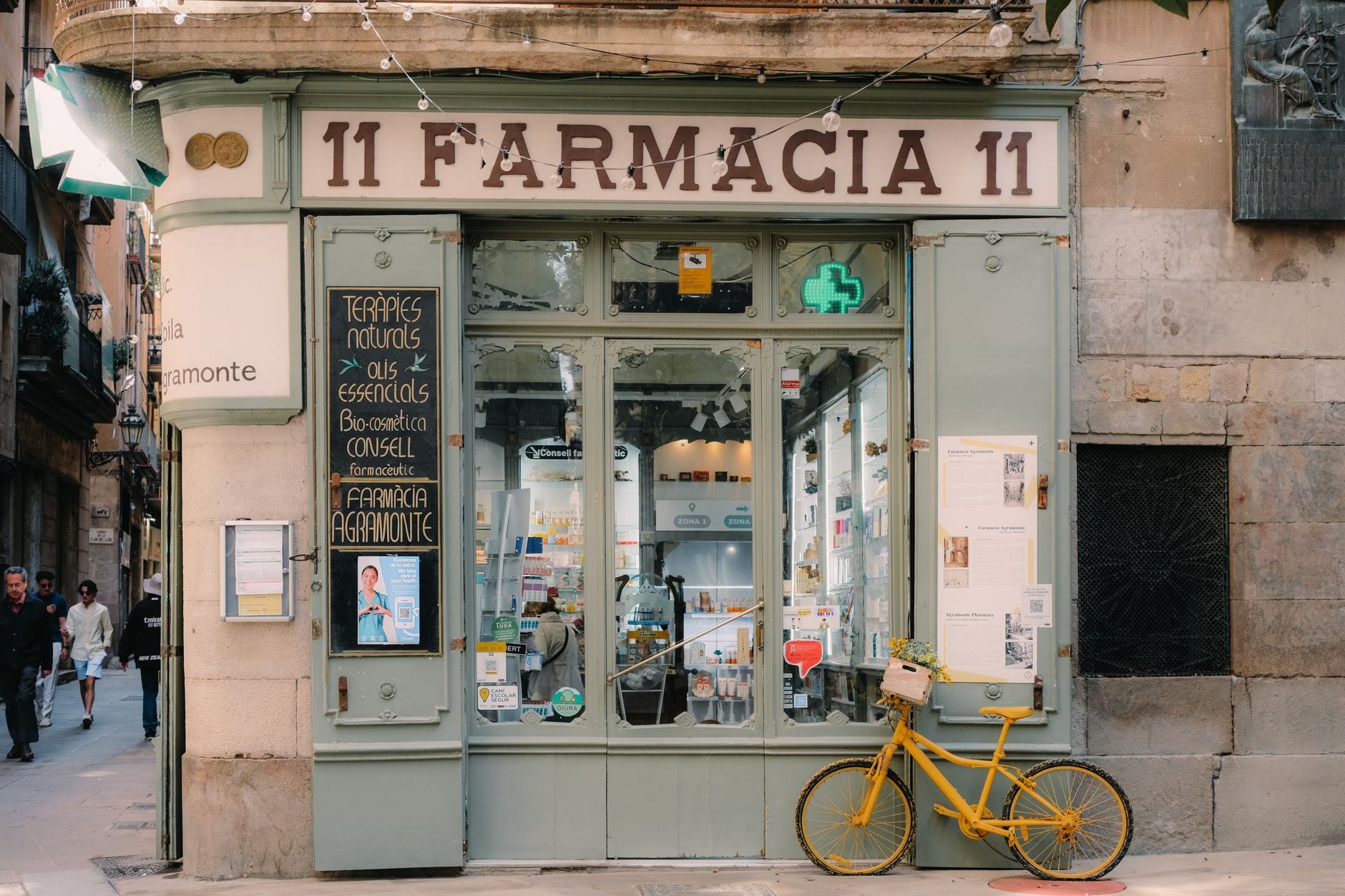
Café au lait? The reason to come in when you are healthy
People usually enter a pharmacy only when they are ill. That limits growth. A health bar with functional drinks could change this by creating a new incentive to visit — and thereby raising customer frequency and turnover.

Key points
- A health bar can increase customer frequency by giving healthy people a reason to visit the pharmacy.
- The range should be evidence-based and underline pharmaceutical competence.
- The legal framework of food law (HACCP, declaration) must be observed without exception.
- The key to success is credibility through honest communication about the effect of the products offered.
Let us briefly do the sums on what the problem actually is.
The average customer enters a pharmacy a few times a year, usually with a specific reason, and leaves again after five minutes. Everything that is optimised in the range operates within this narrow window. Anyone wanting to move turnover appreciably must therefore either sell more per visit, which has its well-known limits, or increase the number of visits.
And for that you need a reason to come in when you are healthy.
A coffee is such a reason. A good coffee is a better one. And a coffee you can get nowhere else, because someone with pharmaceutical training put it together, is a unique selling point.
Why the figures speak for it
The economic appeal lies in the same freedom that makes other secondary ranges interesting: no specialities list, no basic insurance, no distribution share, no tariff agreement. The price is calculated, not decreed, and payment is immediate.
Then there is the frequency logic. A drink is a repeat purchase with a very short interval. Anyone who comes twice a week for a coffee sees the shelf a hundred times a year instead of four. That is the real return of the bar: not the margin on the cup, but the frequency it generates.
And finally it turns waiting time into dwell time. Anyone waiting for a compounded preparation, an order or a vaccination appointment would rather wait seated with a drink than standing at the till. Dwell time correlates in every retail setting with basket size.
The range, sorted by evidence
This is where the pharmacy bar separates itself from the coffee shop, and here lies the entire value of the concept. Customers do not come for the coffee. They come because they assume that here someone knows what is in it.
Level one, undisputed. Hydration, protein, fibre, caffeine. A protein drink for older customers with beginning muscle loss is not a wellness idea but good nutritional medicine. A fibre drink for sluggish digestion likewise. Electrolyte solutions in summer, during sport, after diarrhoea. That is the core, and it is entirely defensible.
Level two, plausible and traditionally supported. Medicinal teas are the most obvious offering of all, because they are in the range anyway and because brewing an individual blend makes visible precisely the competence that otherwise stays in the drawer. Ginger, peppermint, camomile, fennel, lemon balm, sage: familiar, well tolerated, with a tradition of use that does not need to be exaggerated in order to sell it.
Level three, popular and thin. Adaptogen lattes and collagen coffee attract an audience, and the evidence behind them is considerably weaker than the marketing suggests. That is no reason not to offer them. It is a reason to sell them differently: as ritual and taste, not as effect.
The sentence that holds both together goes roughly like this: “That tastes good and probably won’t do you any harm. What actually helps if you sleep badly, we’ll discuss briefly over there.” Anyone selling like that loses no turnover and gains credibility.
What must be clarified legally
As soon as drinks are prepared and dispensed, the pharmacy additionally becomes a food business. A series of obligations follows from this, which must be settled before the first cup.
The business must be notified to the cantonal enforcement authority. Self-monitoring under food law applies, which in practice means a hygiene concept based on HACCP principles, plus staff training, suitable premises with hand-washing facilities, temperature control and documentation. Whether a catering licence is additionally required depends on the canton and on whether consumption takes place on site or only as takeaway; that belongs on the checklist beforehand.
The sharpest restriction applies to communication. Health claims are permissible only if they appear in Annex 14 of the food information ordinance or have been authorised by the Federal Food Safety and Veterinary Office. “Immune booster” is therefore not permissible. “Vitamin C contributes to the normal function of the immune system” is, provided the portion actually delivers the required amount. As soon as a drink promises to cure, alleviate or prevent a disease, it falls under therapeutic products law, and then it becomes uncomfortable.
For collagen there is no authorised health claim relating to skin or joints under current law. You may sell it. You may not advertise with it.
The situation is most confusing with adaptogens, because individual plants count as novel foods or, depending on preparation and dosage, fall into the medicines category. Here clarification is mandatory per plant and per product, not across the board.
The question that decides everything
The profession lives on a single asset, and it is called credibility. A health bar can enlarge or damage it, and the difference lies not in the range but in the tone.
A pharmacy that advertises a drink with unsubstantiated promises sells for twelve francs what it defends for nothing in its counselling. Anyone who explains today why a particular food supplement does not deliver what it promises, and tomorrow makes exactly that promise at their own counter, loses both.
Conversely, the honest variant is a genuine selling point. A menu on which, next to each drink, a single sentence states what is supported and what is not, exists nowhere else. That is precisely the kind of honesty people talk about.
And what else works
The bar is the most conspicuous idea, but not the only one with a short payback.
Rental is astonishingly underdeveloped: breast pumps, inhalation devices, blood pressure monitors, baby scales, crutches and walking frames. Recurring income, low capital commitment, and every return is another customer contact.
Refill stations for cosmetics and care products meet a need that is growing in retail and suit a clientele that comes regularly anyway.
Courses and workshops with limited numbers work if they impart a concrete skill: inhalation technique, blood glucose measurement, wound care, travel medicine kit, first aid for children. The drink from the bar is included in the price, which solves the costing elegantly.
Subscriptions for long-term medication with a weekly dispenser, reminder and fixed collection day retain precisely the clientele that would otherwise migrate to mail order.
And finally the most obvious: one or two seats with a power socket and Wi-Fi. The pharmacy thereby becomes what urban planners call a third place, and third places are visited without any need for an occasion.
The practical test
Before anyone orders an espresso machine, three sober questions.
Who staffs the bar during the flu wave, when three people are missing from the till? If the answer is “somehow, yes”, the concept is not finished. Realistic is a bar with a reduced menu that a trained sales assistant can also handle alone, or a solution with a fully automatic machine and self-service.
How much floor space does it cost, and what stood there before? Two square metres previously occupied by a slow-moving shelf are a good trade. Two square metres of counselling room are not.
And does it add up with realistic volumes? One drink an hour does not cover the cleaning. Fifteen a day change the calculation, and in a location with passing trade that is no bold assumption.
What remains
The real gain of this concept does not show up in the till. It consists in people entering a pharmacy without being ill, and meeting someone there who understands something about health.
That is precisely the position the profession has been claiming for itself for years: first point of contact, low-threshold, preventive. A health bar is the simplest way of not merely asserting that claim but making it tangible.
And incidentally, it smells better.