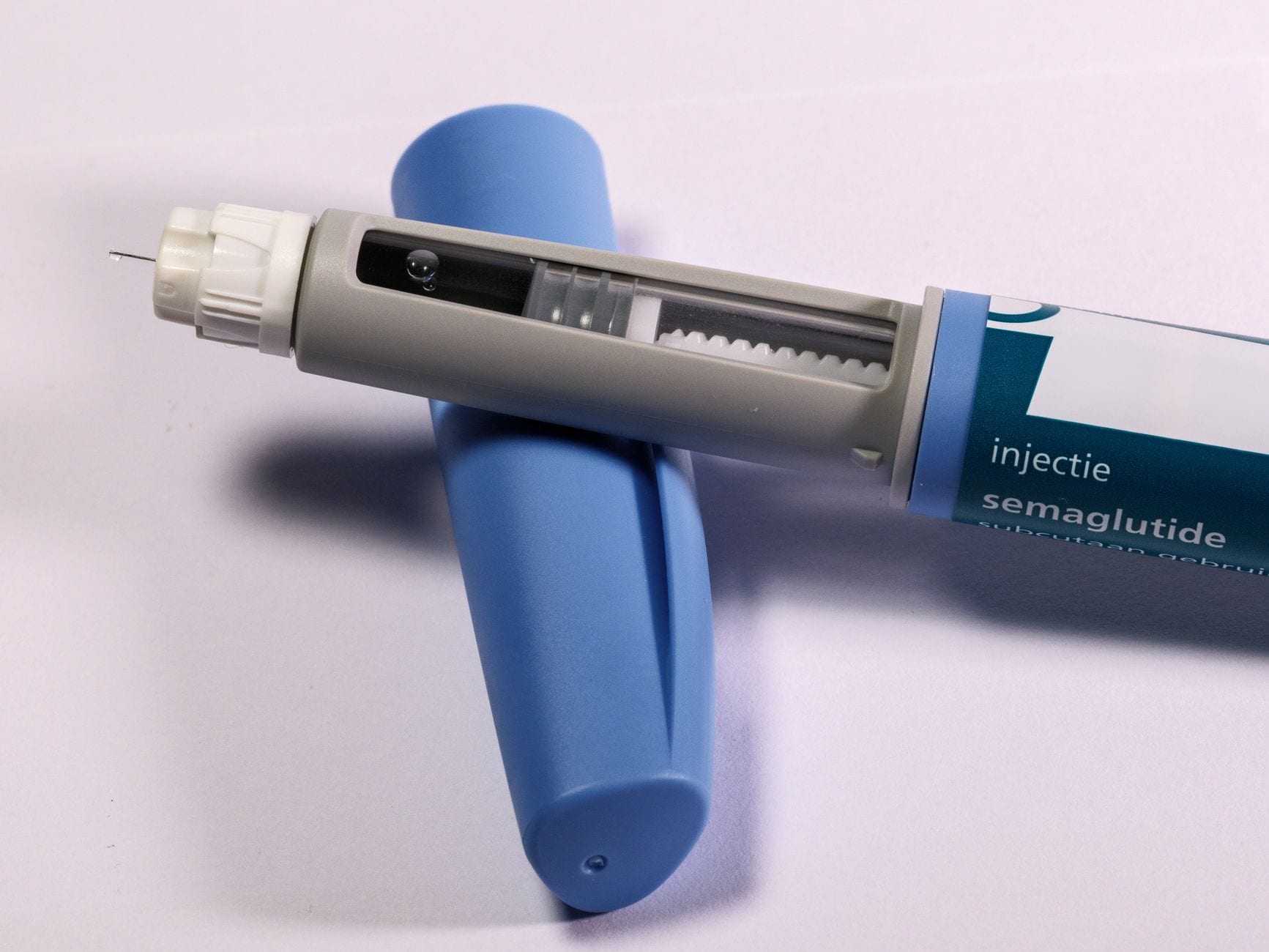
The weight-loss pill. It does not get any simpler.
Oral semaglutide has been approved in the EU for weight regulation since mid-July, a second oral substance is already on the market in the USA, and markedly more potent substances are due in 2027. For the community pharmacy this shifts less the therapy than the counselling load. An assessment as at the end of July 2026.

Key points
- Oral semaglutide is approved in the EU but requires a strict dosing regimen (fasting, 30 min. waiting time), which is a central counselling point.
- For the consultation, the distinction between the pharmacological potential and the weight loss actually achieved in studies is important.
- Further, in part more potent substances (orforglipron, retatrutide) are on the way and will further increase the counselling need in the pharmacy.
- In Switzerland the strict reimbursement rules (limitation) are more decisive than the galenics and lead to more questions from self-payers.
On 15 July 2026 the European Commission approved oral semaglutide 25 mg for weight regulation. It is the first GLP-1 receptor agonist in the EU to be swallowed rather than injected for this purpose, and after the USA, the United Kingdom, the United Arab Emirates and Bahrain it is the fifth approval worldwide. In Germany the tablet is due to reach the market in the third quarter.
In Switzerland nothing changes for the time being. Swissmedic decides independently of the EMA, and in June the institute confirmed that two applications for GLP-1 preparations for weight reduction are pending, without giving details of the procedures. That one of them concerns oral semaglutide is plausible but not confirmed. For the second oral substance, orforglipron, the manufacturer made a Swiss application public in March.
At the pharmacy counter the discussion nonetheless begins now. Anyone who has read the EU announcement asks in the pharmacy, not in Brussels.
What the figures really say
The basis of the approval is OASIS 4, a 64-week, placebo-controlled phase 3 study with 307 adults with obesity or overweight plus at least one weight-related comorbidity, without diabetes. It was published in September 2025 in the New England Journal of Medicine.
Precision pays off here, because two different figures are in circulation. The primary endpoint under the treatment-policy approach, that is regardless of whether participants stuck with the therapy, was minus 13.6 per cent of body weight compared with minus 2.2 per cent under placebo. Counting only protocol-adherent intake, it is 16.6 versus 2.7 per cent. Both values are correct, they simply answer different questions. The second figure describes the pharmacological potential, the first what actually materialises in a study population. Anyone advising patients should know the first.
Around a third of participants treated per protocol lost at least 20 per cent of their starting weight. Gastrointestinal side effects occurred in 74 per cent compared with 42 per cent under placebo, mostly mild to moderate and transient; discontinuations because of adverse effects were at placebo level, 7 versus 6 per cent. Serious adverse events were rarer under the active substance than under placebo.
The approval’s cardiovascular claim rests not on the tablet but on SELECT, an endpoint study with injectable semaglutide 2.4 mg. That is accepted from a regulatory standpoint, but in the consultation it should not be abbreviated to the formulation that the tablet prevented heart attacks.
The real sticking point lies in how it is taken
Semaglutide is a peptide and would be broken down in the gastrointestinal tract. Oral administration is made possible by the absorption enhancer sodium salcaprozate, SNAC for short, which buffers the acidic environment locally and enables uptake through the gastric mucosa. Bioavailability nonetheless remains in the low single-digit percentage range, and it reacts sensitively to anything else in the stomach at the same time.
From this follows a dosing regimen that is more demanding in practice than a weekly injection. The tablet is taken in the morning on an empty stomach, after at least eight hours without food, with no more than 120 millilitres of water, unchewed. Afterwards, for at least 30 minutes: eat nothing, drink nothing else and take no other oral medicines.
The last point is the one the pharmacy has to catch. A patient with levothyroxine in the morning, a proton pump inhibitor before breakfast and a statin does not have a pharmacological problem but a choreographic one. Added to this is delayed gastric emptying under GLP-1 therapy, which can influence the absorption of other oral substances. Anyone who goes through the morning routine cleanly with the customer once and records it in writing prevents precisely those silent losses of effect that are later misinterpreted as non-response.
Practically relevant is also how to handle exceptions. A missed dose cannot be made up during the day, because the fasting window can no longer be established; here the product information’s instruction applies consistently, rather than improvisation. Anyone working shifts, breakfasting irregularly or drinking coffee before their medication in the morning will reliably breach the requirement. That belongs on the table before therapy begins, not after three months without effect.
The second counselling point is a correction of expectations. A tablet seems lower-threshold than an injection, but it is not. It demands daily discipline instead of a weekly appointment, it is equally prescription-only, and the onset of effect is slower.
The third concerns support beyond the substance itself. Gastrointestinal effects occur predominantly during the titration phase and can be cushioned with smaller portions, slower eating and adequate fluid intake; constipation is the reason many affected people come to the counter anyway. Because part of the weight loss under any therapy of this class is lean mass, adequate protein intake and strength training are not a wellness extra but a component of sensible support. And because micronutrient density falls with strong calorie reduction, it is worth looking at basic supply. This is counselling that requires no prescribing authority and makes the pharmacy visible in the treatment pathway.
The injection is not standing still
In parallel, the injection has become more potent. In February 2026 the European Commission approved a higher weekly maintenance dose of semaglutide 7.2 mg, initially as three consecutive injections of 2.4 mg; in July the approval of a ready-to-use single pen for this dose followed. It is indicated for adults with obesity who, after at least four weeks on 2.4 mg, require additional reduction. In the STEP UP study with 1,407 participants, mean weight loss was around 21 per cent compared with about 2 per cent under placebo, with 84 per cent of the loss being fat mass.
One safety signal belongs in every consultation on the higher dose: dysaesthesia and altered skin sensations occurred in 22 per cent under 7.2 mg, compared with 6 per cent under 2.4 mg. That is rarely therapy-limiting, but frequent enough for those affected to come to the counter with it.
What is knocking in 2027
Orforglipron. The first non-peptide, small-molecule GLP-1 receptor agonist was approved in the USA on 1 April 2026, through a pilot programme for accelerated procedures and thus as the fastest approval of a new active substance since 2002. Pharmaceutically this is the more interesting advance: because it is not a peptide, SNAC, the fasting window and the water limit all fall away. It can be taken independently of food and fluids. In ATTAIN-1 with 3,127 adults without diabetes, weight reduction after 72 weeks was dose-dependently 7.5, 8.4 and 11.2 per cent compared with 2.1 per cent under placebo; with continuous intake of the highest dose, 12.4 per cent. The substance therefore acts more weakly than high-dose semaglutide, but it can be produced synthetically and is thus scalable, which could mean more for availability and price than a few percentage points. A liver injury signal that had stopped a related development substance was not observed. The EMA procedure is running; in May 2026 it was at the list-of-questions stage, so an EU decision is realistically expected in 2027.
Cagrilintide plus semaglutide. The fixed combination of an amylin analogue and a GLP-1 receptor agonist, once weekly subcutaneously, was submitted in the USA in December 2025; the regulatory decision is expected in the fourth quarter of 2026. In REDEFINE 1 with 3,417 adults, mean weight loss after 68 weeks was 20.4 per cent under the treatment-policy approach and around 23 per cent with continuous treatment, compared with 3.0 per cent under placebo. In the diabetes population the reduction was, as expected, smaller. The combination has so far been approved neither in the USA nor in the EU.
Retatrutide. The triple agonist at GLP-1, GIP and glucagon receptors delivered the first results of the pivotal TRIUMPH-1 study with 2,339 adults on 21 May 2026. After 80 weeks, weight loss with continuous treatment was 19.0, 25.9 and 28.3 per cent for 4, 9 and 12 mg. Under the treatment-policy approach, that is including discontinuations, it was 17.6, 23.7 and 25.0 per cent compared with 3.9 per cent under placebo. In an extension in people with a baseline BMI of 35 or above, a good 30 per cent on average was reached after 104 weeks. This brings within pharmacological reach an order of magnitude previously reserved for bariatric surgery. Two caveats belong with it: this is a topline announcement from the manufacturer, not a peer-reviewed publication, and the discontinuation rate due to adverse effects rose dose-dependently to 11.3 per cent under 12 mg. An application is expected in 2026, approval at the earliest in 2027, and correspondingly later in Europe.
Amycretin. A single molecule with GLP-1 and amylin activity, in oral and subcutaneous form and in phase 3 since 2026. That is the generation after next, not the one for 2027.
The Swiss framework decides, not the galenics
The decisive question for the community pharmacy is not when the tablet arrives, but under what conditions it is reimbursed. For injectable semaglutide therapy, a narrow limitation has applied since March 2024: prescription exclusively by specialists in endocrinology and diabetology or at obesity centres, documented nutritional counselling as a condition of reimbursement, defined discontinuation criteria in case of insufficient response. Inclusion in the specialities list is time-limited – for semaglutide until the end of February 2027 – and the FOPH has announced that it will then re-examine efficacy, appropriateness and cost-effectiveness. The cost pressure is real: health insurers now put spending on this substance class in the hundreds of millions of francs per year.
An oral form lowers the psychological hurdle, not the regulatory one. It is precisely in this gap that work arises for the pharmacy: more self-payers, more procurement through foreign mail-order channels, more questions about preparations not approved here at all, and more people coming to the counter with an expectation rather than a prescription. A survey published in May 2026 by the Gottlieb Duttweiler Institute arrived at a surprisingly high share of the Swiss population already taking a GLP-1 preparation for weight reduction. Whether the figure is robust remains to be seen; that demand has long overtaken the formal routes of access it shows in any case.
Added to this is a risk that grows with every oral form. As long as demand exceeds regular supply, procurement routes remain attractive that guarantee neither quality nor dosage. A tablet is easier to ship, easier to store and easier to copy than a prefilled pen. The pharmacy is the only place in the system where anyone is asked this question at all, and it should be prepared for it without lecturing.
Anyone preparing now does three things: standardise the fasting regimen and the 30-minute rule as a written dosing aid, actively ask about the morning medication of polymedicated customers, and be able to keep the two percentage figures per study apart. The rest is a matter of timing.