Resistant gonorrhoea on the rise
Gonorrhoea was long regarded as a straightforwardly treatable bacterial infection. That assessment is increasingly being shaken. In July 2026 the European Centre for Disease Prevention and Control (ECDC) warned for the first time explicitly of increasing local transmission of ceftriaxone-resistant gonococci in Europe. At the same time, with zoliflodacin and gepotidacin, new antibiotics are available for the first time in decades. Between growing resistance and therapeutic innovation, the pharmacy is gaining new significance as a low-threshold point of contact.

When a long-familiar pathogen becomes a threat again
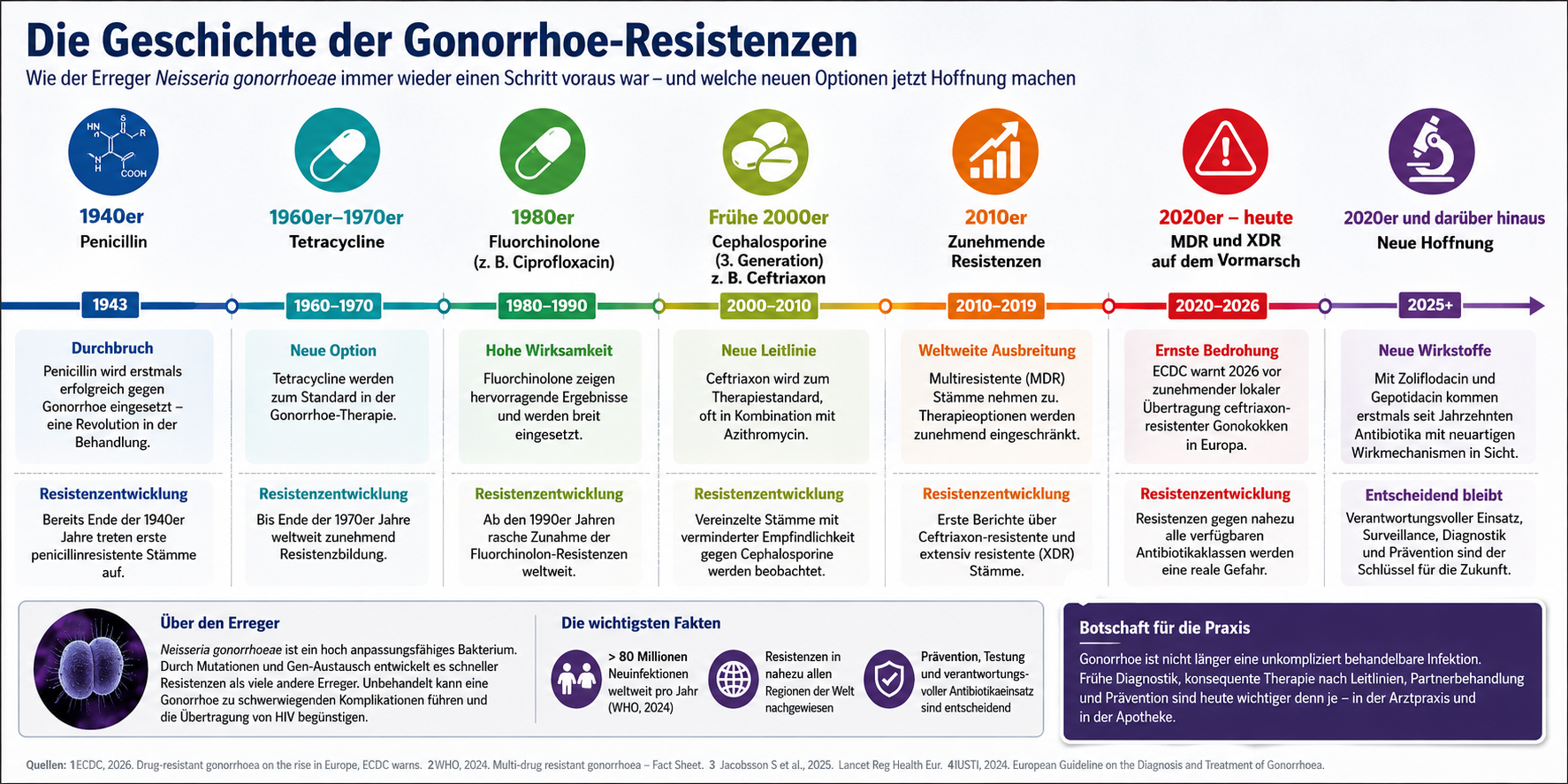
Hardly any bacterial infectious disease illustrates the problem of antibiotic resistance as vividly as gonorrhoea. The sexually transmitted infection caused by Neisseria gonorrhoeae is among the most frequent STIs worldwide. According to estimates by the World Health Organization (WHO), more than 80 million people are newly infected with gonorrhoea each year.[2]
For decades the disease was readily treatable. But the pathogen possesses an exceptional ability to develop resistance to antibiotics. Sulfonamides, penicillin, tetracyclines, fluoroquinolones and later macrolides all gradually lost their effectiveness.[3] Today ceftriaxone, a third-generation cephalosporin, in combination with targeted diagnostics and resistance surveillance, forms the most important pillar of therapy.[4]
It is precisely this last reliable treatment option that is now coming under increasing pressure.
The ECDC sounds the alarm
On 16 July 2026 the ECDC published a new risk assessment that attracted considerable attention among specialists.[1] Whereas resistant gonococci had until now been regarded predominantly as imported isolated cases following travel to South-East Asia or the Pacific region, a different picture is now emerging.
Several European countries report a rising number of gonorrhoea cases with reduced or complete resistance to ceftriaxone. Particularly worrying is that these infections increasingly occur without any travel history. For the first time, therefore, local transmission within Europe is considered likely.[1]
In parallel the ECDC published an evaluation report on the European resistance programme. It shows that while progress has been made on guidelines and surveillance, deficits remain in the detection of treatment failure, in microbiological diagnostics and in systematic resistance surveillance.[5]
For Europe this means a paradigm shift: the development of resistance is no longer a problem of isolated imported cases but is increasingly becoming a challenge for public healthcare.
What does “multidrug-resistant” actually mean?
Not every resistant gonorrhoea is equally dangerous. Professional bodies distinguish between multidrug-resistant (MDR) and extensively drug-resistant (XDR) gonococci.
One speaks of multidrug-resistant gonorrhoea when the pathogen has become insensitive to several important classes of antibiotics. Extensively resistant strains additionally show resistance to virtually all available treatment options and can in individual cases scarcely be treated at all.[6]
The XDR strains identified in recent years showed, among other things, resistance to ceftriaxone and at the same time to azithromycin, ciprofloxacin and further reserve antibiotics. Such cases were initially described above all in Japan, the United Kingdom and France. There are now increasing indications of further spread within Europe.[1,6]
These are still comparatively few cases. From an infectiology standpoint, however, they are of high relevance, since even individual resistant clones can lead to regional outbreaks.
Why gonorrhoea develops resistance so adeptly
Neisseria gonorrhoeae is among the most adaptable bacterial pathogens of all. Unlike many other bacteria, the pathogen alters its genome exceptionally quickly and can acquire resistance genes both through spontaneous mutations and through genetic exchange with other Neisseria species.[3]
In addition, gonococci frequently colonise the throat. It is precisely there that they encounter numerous harmless Neisseria species with which genetic material can be exchanged. The pharynx is therefore regarded as a central reservoir for the emergence of new resistances.[3]
A further factor is the frequently symptom-poor or entirely asymptomatic infection. An estimated up to 80 per cent of women, and a considerable proportion of pharyngeal or rectal infections, initially run without complaints.[2] The disease thus often remains undetected and is passed on unwittingly.
Switzerland is no island
Even though no widespread occurrence of ceftriaxone-resistant gonococci has so far been documented in Switzerland, specialist bodies are watching the development attentively. International travel, cross-border mobility and closely networked sexual contacts make a spread here fundamentally possible too.
At the same time, reported gonorrhoea cases have been rising continuously for years. Specialists also assume a considerable number of unreported cases, since many infections run asymptomatically or are not tested for at all because of shame or the absence of symptoms.[2]
For Swiss pharmacies this means that the likelihood is increasing of advising customers with questions about STIs, self-tests or first symptoms. The community pharmacy is thus increasingly developing into an important interface between prevention, early detection and medical care.
New hope from new antibiotics, but no all-clear
For decades the development of new antibiotics against Neisseria gonorrhoeae was almost at a standstill. While the pathogen continuously developed new resistances, hardly any new substances came onto the market. Attention was correspondingly great when, with zoliflodacin and gepotidacin, two new antibiotics with novel mechanisms of action showed convincing results in clinical trials for the first time.[7,8]
Zoliflodacin inhibits the bacterial DNA gyrase at a different binding site from fluoroquinolones and thereby remains effective against many resistant gonococci as well. In the phase 3 studies to date, the substance achieved high microbiological cure rates in uncomplicated urogenital gonorrhoea.[7] Particularly encouraging is that no cross-resistance to the standard antibiotics used today has so far been observed.
Gepotidacin, too, belongs to a new class of antibiotics. It likewise inhibits bacterial DNA replication, but through a different mechanism from previously available substances. The international phase 3 study EAGLE-1 showed non-inferiority to the previous standard therapy of ceftriaxone plus azithromycin in uncomplicated gonorrhoea.[8]
Despite this progress, infectiologists urge restraint. New antibiotics do not solve the resistance problem permanently. The experience of recent decades shows rather that virtually every newly introduced class of antibiotics sooner or later loses effectiveness through the development of resistance.[3] What remains decisive is therefore responsible use in the sense of antibiotic stewardship.
Why diagnostics matter more today than ever
The era of empirical treatment without microbiological confirmation is increasingly coming to an end. Whereas in the past treatment was frequently based on symptoms alone, targeted diagnostics is now gaining considerably in importance.
Molecular nucleic acid amplification tests (NAAT) do have very high sensitivity and today represent the diagnostic standard for detecting the pathogen.[9] For determining resistance, however, they are not sufficient. That still requires cultured pathogens with subsequent susceptibility testing.
It is precisely here that professional bodies currently see one of the greatest challenges. Since in many countries almost exclusively PCR-based diagnostics are used, important information on the resistance situation is lost.[5] The ECDC therefore expressly calls for culture-based diagnostics to be reintegrated more strongly into routine care and for treatment failures to be consistently investigated microbiologically.[1]
For the pharmacy this also carries an important message in counselling: a negative self-test or purely PCR-based detection in no way replaces a medical examination with resistance diagnostics where treatment failure or persistent complaints are suspected.
What role do STI self-tests play?
In parallel with the development of resistance, the market for STI self-tests is growing rapidly. More and more manufacturers offer home tests for chlamydia, gonorrhoea or combined STI panels. This development opens up opportunities but at the same time raises new questions regarding quality, informative value and counselling.
While validated sample collection kits with laboratory analysis can now achieve good diagnostic reliability, rapid tests differ considerably in sensitivity and specificity.[10] Only recently, an approved home test in Australia had to be withdrawn from the market as a precaution after reports of false-negative results.[11] The case illustrates that regulatory approvals alone are no guarantee of lastingly high diagnostic quality.
For pharmacies this creates a demanding counselling task. Customers increasingly expect guidance on which test is suitable in which situation, when a negative result can be reliably interpreted and when medical assessment remains necessary despite an unremarkable result.
For gonorrhoea in particular the rule is: a negative self-test does not reliably exclude an infection, especially shortly after a risk situation or with unsuitable sample collection. Nor can a self-test say anything about possible antibiotic resistance.
The pharmacy becomes the first port of call
In many European health systems the role of the community pharmacy is noticeably changing. Whereas STI counselling used to take place almost exclusively in medical practices or specialised centres, more and more people today first go to the pharmacy. The reasons for this are its low-threshold accessibility, longer opening hours and the possibility of discreet initial counselling.
International studies show that pharmacies can make an important contribution to public health, particularly in educating about transmission routes, assessing individual risk situations and recommending suitable testing procedures.[12]
In Switzerland too, the range of pharmaceutical services is continuously expanding. Numerous pharmacies already advise on HIV pre-exposure prophylaxis (PrEP), HPV vaccination, emergency contraception or STI self-tests. The increasing development of resistance is likely to strengthen this role further in future.
This is less about making diagnoses or initiating therapies. Rather, the pharmacy’s strength lies in reducing uncertainty, recognising risk situations early and guiding patients quickly to the right level of care. Particularly in asymptomatic infections, this low-threshold counselling can help to break chains of transmission early.
MDR and XDR explained simply
MDR (multidrug resistant) describes gonococci that are resistant to several important classes of antibiotics. These can include, for example, resistance to penicillins, fluoroquinolones, macrolides and tetracyclines. The disease is frequently still treatable, but the treatment options are markedly restricted.[6]
XDR (extensively drug resistant) denotes pathogens that have additionally developed resistance to the remaining effective reserve antibiotics, in particular third-generation cephalosporins such as ceftriaxone. Such infections are so far an exception worldwide but are regarded as a serious threat to public health.[6]
For practice this means: not every resistant gonorrhoea is automatically “incurable”. Nonetheless, MDR and XDR strains illustrate how urgently new antibiotics, consistent resistance surveillance and early diagnostics are needed.
Counselling is changing, and with it the professional profile
The increasing development of resistance in Neisseria gonorrhoeae is changing not only medical treatment but also the demands on healthcare professionals. For pharmacies this means that the classic dispensing of medicines is increasingly complemented by evidence-based prevention and health counselling.
Particularly with sexually transmitted infections, many of those affected first seek out the most low-threshold point of contact possible. Shame, uncertainty or the fear of stigmatisation frequently mean that advice is first sought in the pharmacy. This gives pharmacists the opportunity to inform early, to advise on suitable testing procedures and, where gonorrhoea or another STI is suspected, to refer promptly for medical diagnostics.[12]
Of central importance here is non-judgemental communication. Counselling should consistently be oriented towards individual risk situations, not towards supposed risk groups. International guidelines expressly recommend a person-centred counselling approach that understands sexual health as a self-evident component of healthcare.[9]
Preventive measures are also gaining further importance. Alongside recommending consistent condom use, these include education about regular STI screening where exposure risk is elevated, HPV vaccination and information on HIV pre-exposure prophylaxis (PrEP), where that is relevant to the individual situation.[2,12]
The pharmacy is thus increasingly developing into a link between prevention, diagnostics and medical care. Particularly in a health system with limited medical resources, this pilot function may gain considerably in importance in future.
What pharmacists should concretely recommend to patients today
Where gonorrhoea is suspected or after a risk situation, pharmacists should first ask about the complaints, the timing of a possible risk contact and the type of sexual exposure. If an STI is suspected, medical assessment with suitable diagnostics should follow promptly.
Until the results of the investigation are available, unprotected sexual contact should be avoided. It is also important to point out that sexual partners must be examined and, where applicable, treated, in order to prevent renewed infection.
Self-tests can be a useful complement in suitable situations, but they replace neither medical diagnostics nor resistance testing. Persistent complaints despite treatment, or symptoms that reappear, should always be an occasion for further investigation.
The pharmacy thereby takes on an important pilot function: it creates orientation, lowers inhibitions and supports patients in obtaining the right medical care early.
Case vignette
“It stings a bit – probably just a bladder infection.”
A 28-year-old man walks into the pharmacy on a Saturday morning. He reports mild burning on urination and asks for a herbal preparation for a suspected bladder infection. In conversation he mentions that about ten days ago he had unprotected intercourse with a new partner. He has no other complaints.
The pharmacist recognises that the symptoms could equally point to gonorrhoea or another sexually transmitted infection. She does not recommend self-medication but explains the importance of prompt medical assessment with targeted diagnostics. At the same time she informs the patient that he should refrain from sexual contact until a test result is available and, where appropriate, also inform his sexual partner about possible exposure.
A few days later a nucleic acid amplification test confirms gonorrhoea. Thanks to the early counselling, targeted treatment could be initiated and further transmission prevented.
Message for practice: it is frequently not the symptoms that are decisive but the right history-taking questions. A discreet, open way of conducting the conversation can contribute substantially to detecting sexually transmitted infections early.
In brief
The history of gonorrhoea shows impressively how quickly medical successes can be called into question again by bacterial adaptation mechanisms. While penicillin in the 1940s was regarded as almost revolutionary, today even modern reserve antibiotics are under growing pressure.
With zoliflodacin and gepotidacin, new therapeutic options are in prospect for the first time in decades. At the same time, current developments make clear that resistance problems cannot be solved by new antibiotics alone. What remains decisive is responsible antibiotic use, consistent resistance surveillance, modern diagnostics and effective prevention.
For pharmacies this opens up a new field of activity. The community pharmacy is increasingly developing into a place of sexual health counselling, where prevention, early detection and evidence-based information come together. Precisely with sensitive topics such as sexually transmitted infections, low-threshold counselling can make a decisive contribution to breaking chains of infection early and guiding patients into the right care.
Resistant gonorrhoea is therefore far more than an infectiology problem. It illustrates how the professional profile of the pharmacy is changing, from the classic dispensing of medicines to a central actor in modern primary care.
References
- European Centre for Disease Prevention and Control (ECDC). Drug-resistant gonorrhoea on the rise in Europe, ECDC warns. 16. Juli 2026.
- World Health Organization (WHO). Epidemiologie der Gonorrhoe und globale STI-Daten.
- Jacobsson S, et al. Antimicrobial resistance in Neisseria gonorrhoeae and its public health implications. The Lancet Regional Health – Europe. 2025.
- Europäische Leitlinien zur Behandlung der Gonorrhoe sowie ECDC-Empfehlungen.
- ECDC. Progress towards implementation of the Response Plan to control and manage the threat of multidrug-resistant gonorrhoea in Europe. Juli 2026.
- WHO. Multi-drug resistant gonorrhoea. Hintergrundpapier und Lagebeurteilung.
- Taylor SN, et al. Phase 3 trial of zoliflodacin for uncomplicated gonorrhoea. New England Journal of Medicine. 2025.
- O’Donnell J, et al. EAGLE-1: Gepotidacin versus ceftriaxone plus azithromycin for uncomplicated gonorrhoea. The Lancet. 2025.
- International Union against Sexually Transmitted Infections (IUSTI). European Guideline for the Diagnosis and Treatment of Gonorrhoea. 2024.
- World Health Organization. Recommendations on sexually transmitted infection testing and diagnostics. 2024.
- Therapeutic Goods Administration (Australia). Safety alert regarding home STI test performance. Juli 2026.
- International Pharmaceutical Federation (FIP). Community pharmacists’ role in sexual and reproductive health services. 2025.