
Supplementing vitamin D correctly — between sunshine vitamin, hype and evidence
Vitamin D is among the most widely discussed micronutrients of recent years. Hardly any other supplement moves so strongly between medical evidence, lifestyle trend and public health debate. Demand in the pharmacy is particularly high: tiredness, susceptibility to infection, low mood or diffuse muscle pain lead many patients straight to the question of vitamin D. But when is supplementation actually appropriate? Which doses count as evidence-based? And where are the limits of self-medication?
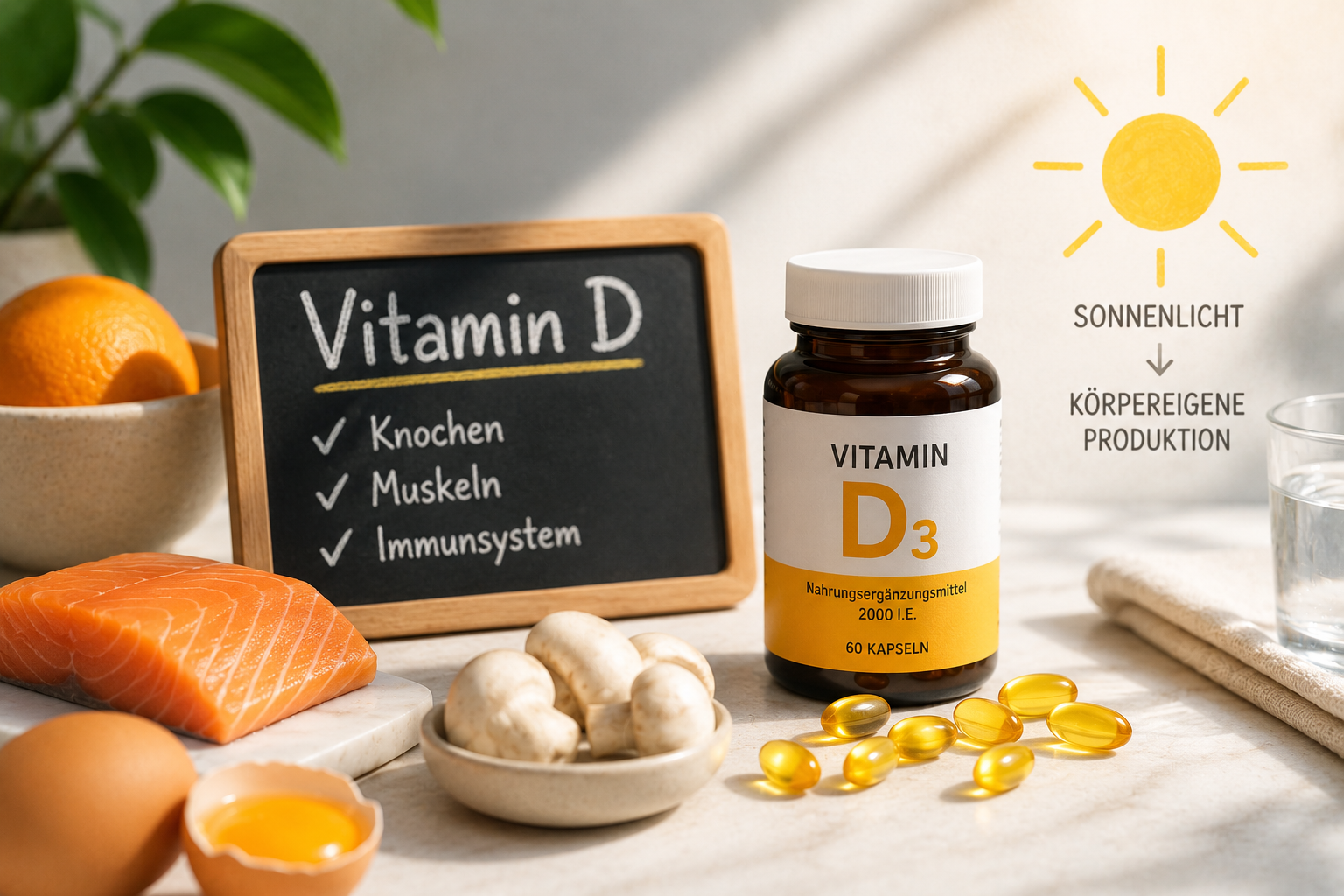
Why vitamin D is so important
Vitamin D occupies a special place among the vitamins, because the human body can produce it itself under UVB radiation. Strictly speaking it is therefore more a prohormone than a classic vitamin.¹
Its best-known function lies in calcium and bone metabolism. Vitamin D promotes calcium absorption in the gut and contributes substantially to the mineralisation of the skeleton. Beyond that it plays a role in muscle health, immune regulation and cell function.²
In central Europe, vitamin D deficiency is widespread — especially during the winter months. Risk groups include:
- older people
- people with little sun exposure
- residents of care institutions
- people with dark skin
- patients with obesity
- patients with chronic bowel disease or malabsorption³
Non-specific symptoms make diagnosis harder
Vitamin D deficiency often develops insidiously. The symptoms are frequently non-specific and can have numerous causes. Typical complaints are:
- tiredness and exhaustion
- muscle weakness
- diffuse muscle and bone pain
- increased susceptibility to infection
- depressive mood
- increased tendency to fall in older patients²
Severe deficiency can contribute in the long term to osteomalacia or osteoporosis. In children, rickets threatens in extreme cases.¹
What is decisive, however, is this: not every case of tiredness is automatically a vitamin D deficiency. Supplementation should ideally follow a clinical assessment and — in risk groups — a laboratory determination of the 25-OH vitamin D level.⁴
Supplementation: when it makes sense
Professional societies recommend vitamin D supplementation particularly where the body’s own synthesis cannot be adequately guaranteed. This applies above all to the winter months in Europe.³
For adults, depending on the guideline, daily doses between 800 and 2,000 IU are generally regarded as sensible and safe.² High-dose preparations at weekly or monthly intervals are also used, but should be given in a targeted and monitored way.⁴
As a rule:
- daily intake leads to more stable levels
- fat-soluble uptake improves bioavailability
- taking it with a meal increases absorption⁵
In the pharmacy, attention should also be paid to double supplementation, since vitamin D is frequently already contained in multivitamin preparations.
More is not automatically better
The vitamin D boom of recent years led in part to very high doses, frequently without medical indication. Today, however, it increasingly holds that unnecessary high dosing brings no additional health benefit.⁶
Low vitamin D levels are indeed associated with numerous diseases, including cardiovascular disease, diabetes and depression. A causal benefit of high-dose supplementation could often not be clearly demonstrated in large trials, however.⁶
In addition, long-term overdosing can become problematic. Because vitamin D is fat-soluble, it can be stored in the body. Possible consequences of hypervitaminosis D are:
- hypercalcaemia
- kidney stones
- nausea and vomiting
- cardiac arrhythmias
- kidney damage⁵
Counselling in the pharmacy should therefore be evidence-based and not driven purely by trends.
Diet and sunlight: the basics remain decisive
Only a few foods contain relevant amounts of vitamin D. They include in particular:
- oily fish (e.g. salmon, herring, mackerel)
- egg yolk
- liver
- fortified foods⁵
The most important source, however, remains the body’s own synthesis via sunlight. In summer, even short periods outdoors can be sufficient. In winter, though, UVB intensity in central Europe is often not enough.³
At the same time, the recommendation on sun exposure should always be weighed against the risk of skin cancer.
What role does the pharmacy play?
Vitamin D is one of the classic counselling-intensive supplements. Pharmacists take on an important role in:
- interpreting non-specific complaints
- selecting suitable doses
- avoiding overdosing
- identifying risk groups
- promoting evidence-based supplementation
In the field of food supplements in particular there is a high need for information, and at the same time considerable uncertainty created by social media, influencers and aggressive marketing promises.
Conclusion for pharmacy practice
Vitamin D remains an important element of modern prevention and supplementation strategies, especially in months with little sun and in risk groups. At the same time, the current evidence shows clearly that not every low laboratory value automatically justifies high-dose therapy.
For the pharmacy this means individual counselling instead of blanket recommendations. Risk profile, lifestyle, dosage and realistic expectations of supplementation are decisive. That is precisely where the pharmaceutical added value of modern micronutrient counselling lies.
References
- Holick MF. Vitamin D deficiency. N Engl J Med. 2007;357(3):266–281.
- Bundesamt für Gesundheit (BAG). Vitamin D – Empfehlungen und Versorgung in der Schweiz. BAG, 2022.
- Office fédéral de la santé publique / Schweizerische Gesellschaft für Ernährung. Vitamin-D-Versorgung in der Schweiz. 2023.
- Endocrine Society. Evaluation, Treatment, and Prevention of Vitamin D Deficiency: Clinical Practice Guideline. J Clin Endocrinol Metab. 2011;96(7):1911–1930.
- Harvard T.H. Chan School of Public Health. Vitamin D – The Nutrition Source. Harvard University, 2024.
- Manson JE, Cook NR, Lee IM et al. Vitamin D Supplements and Prevention of Cancer and Cardiovascular Disease. N Engl J Med. 2019;380:33–44.