
When the ring talks to the injection
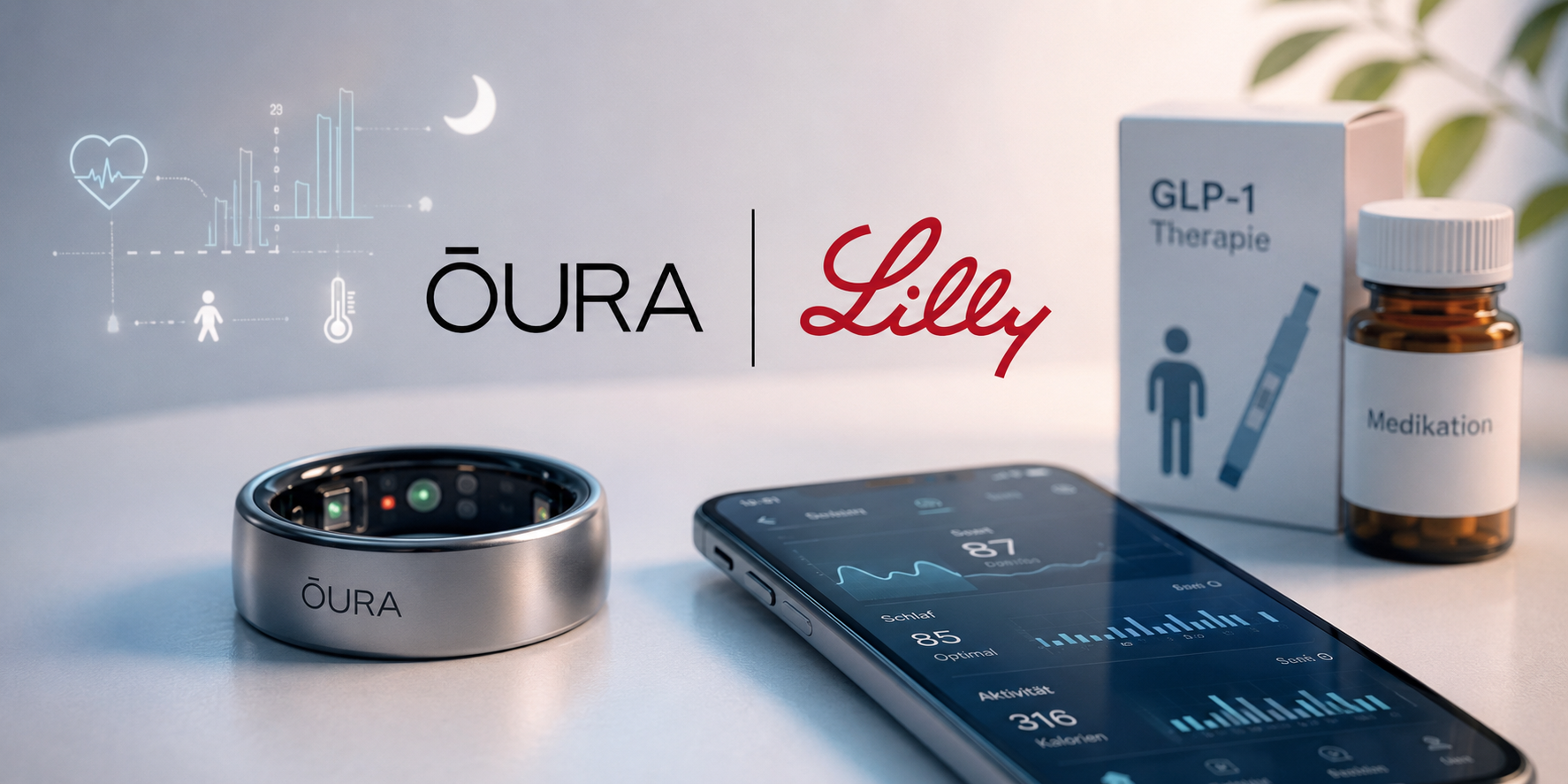
What happens when one of the world’s largest pharmaceutical companies invests in a smart ring? Presumably far more than an ordinary deal. The strategic partnership between Eli Lilly and Oura shows where health care is heading: medicines, wearables and artificial intelligence are growing together into a digital health ecosystem. For patients this opens up new possibilities for personalised therapy — and pharmacies too could in future take on a more important role in interpreting digital health data.
From the medicine to the health platform
When Eli Lilly announced a strategic stake in the wearable manufacturer Oura in July 2026, it attracted attention above all in the digital health sector.¹ At first glance it is an investment by a pharmaceutical group in a technology company. On closer inspection, however, the cooperation stands for a fundamental shift in health care.
For a long time the task of a pharmaceutical company was to develop, clinically test and market medicines. Today that understanding is less and less sufficient. Chronic conditions such as obesity or diabetes require long-term support for patients, far beyond drug therapy itself. This is precisely where digital health platforms come in.
The stake in Oura makes clear that in future Eli Lilly wants to offer not only medicines but a comprehensive ecosystem linking therapy, health data and digital support.
More than a smart ring
The Oura Ring is today among the leading wearables in the health field. Unlike classic fitness trackers, the ring focuses on the continuous recording of physiological parameters such as sleep quality, heart rate, heart rate variability, respiratory rate, skin temperature, activity and recovery.² From these measurements so-called digital biomarkers are calculated, allowing conclusions about general health status.
With the introduction of the GLP-1 Insights function, Oura has extended its platform specifically to people using medicines to treat obesity or diabetes. Users can document their medication intake and link it to sleep, activity, weight development and further health parameters.³
In parallel, Oura is already working with LillyDirect, Eli Lilly’s digital health platform. Patients starting a GLP-1 therapy there gain access to the Oura ecosystem and can follow the course of their therapy digitally.⁴
The real innovation does not lie in the ring
What is decisive is not the wearable itself but the new approach to treatment.
Until now the success of a therapy was usually assessed at individual medical appointments. Weight, laboratory values or blood pressure provide only snapshots. What happens between these appointments frequently remains unknown.
Wearables fundamentally change this perspective. They record health data continuously and thereby allow a considerably more comprehensive view of the course of therapy.
Is sleep improving? Is physical activity increasing? How is the stress level developing? Are there changes in recovery, or indications of side effects?
In GLP-1 therapies in particular, such information could in future help to identify discontinuation early, to assess treatment success better and to support patients more individually.
Drug therapy thereby develops from a point-in-time treatment into continuous support.
Health data become the new currency
With its investment, Eli Lilly is not only pursuing the goal of offering patients an additional service. The partnership rather illustrates the growing importance of so-called real-world data.
While clinical trials show how a medicine works under controlled conditions, wearables provide information about how patients actually develop in everyday life.
How does the activity level change after therapy begins? Does sleep quality improve? Which behaviour patterns favour therapeutic success? When might patients discontinue their treatment prematurely?
Such insights can help to understand therapies better and to personalise them more strongly in future.
Important in this context: according to the companies, no individual user data is exchanged between Oura and Eli Lilly within the current collaboration.⁵
Connected care — the future of provision
Many experts see this cooperation as the beginning of a new care concept: connected care.
In it, medicines, digital health applications, wearables, telemedicine and artificial intelligence are networked with one another.
It is conceivable, for instance, that patients starting a GLP-1 therapy will in future automatically receive a wearable. The continuously recorded health data could help physicians and (with the patient’s consent) also pharmacists to adjust therapies earlier and to recognise risks more quickly.
Artificial intelligence could identify patterns that are barely visible to the human eye and derive personalised recommendations for action.
Health care would thereby develop from episodic treatment into ongoing support.
Expert view: digital biomarkers — the next big topic?
Today wearables serve many people above all for monitoring fitness and sleep. In medicine, however, a new field of research is developing: digital biomarkers. These are objective health data recorded continuously by digital technologies and allowing conclusions about health status. The Oura Ring measures heart rate, heart rate variability, sleep quality, activity, respiratory rate and changes in skin temperature, among other things. Individual parameters are already being used in scientific studies today to understand disease courses better or to investigate treatment effects. Digital biomarkers do not yet replace laboratory values or clinical examinations. They do, however, supplement them with information from everyday life — precisely where the greater part of a chronic condition takes place. Should this development continue, wearables could in future acquire a status similar to that of blood pressure monitors or continuous glucose sensors: as a self-evident component of personalised health care.
What does this mean for community pharmacies?
Community pharmacies in particular could benefit from this development.
Pharmacists already accompany numerous patients through GLP-1 therapy today. Questions about side effects, nutrition, muscle loss or adherence have long been part of everyday counselling.
Digital health data could usefully supplement this counselling in future. Instead of relying exclusively on subjective statements, objective information about sleep, activity or recovery could (with the patient’s consent) feed into the conversation.
Beyond that, wearables could in future become part of pharmaceutical services themselves. Much like blood pressure measurement or medication reviews, pharmacies could support patients in using and interpreting digital health data.
The role of the pharmacy would thereby continue to evolve — from classic medicine dispensing towards a modern health hub that links prevention, therapy and digital care.
In brief
Eli Lilly’s stake in Oura is far more than an ordinary investment. It shows in exemplary fashion how health care is changing.
In future, medicines will increasingly be part of a digital ecosystem that links continuous health data, artificial intelligence and personalised support.
For patients this means the chance of more individual therapies and closer accompaniment. For community pharmacies it opens up the possibility of developing their role as competent health advisers further and of integrating digital health applications actively into pharmaceutical care.
The decisive question is therefore no longer whether wearables will be part of modern therapies, but how quickly they find their way into everyday care.
References
- Oura Health. Oura Announces Strategic Investment from Eli Lilly to Advance Connected Health. 2026. https://ouraring.com/blog/lilly-equity-investment/
- Oura Health. Oura Ring – Health Sensing Technology. https://ouraring.com
- Oura Health. GLP-1 Insights. Produktinformationen zur Begleitung von GLP-1-Therapien. https://ouraring.com
- MobiHealthNews. Oura, LillyDirect team up to support GLP-1 users. 23. Juni 2026.
- Healthcare Brew. Why Eli Lilly is collaborating with Oura. 25. Juni 2026.
- HLTH. Oura and LillyDirect Partner to Support GLP-1 Users with Wearable Insights and Care Tools. 2026.
- Journal of Medical Internet Research (JMIR). Accuracy Assessment of Oura Ring Nocturnal Heart Rate and Heart Rate Variability in Comparison With Electrocardiography.
- U.S. Food and Drug Administration (FDA). Digital Health Technologies for Remote Data Acquisition in Clinical Investigations – Guidance for Industry.